
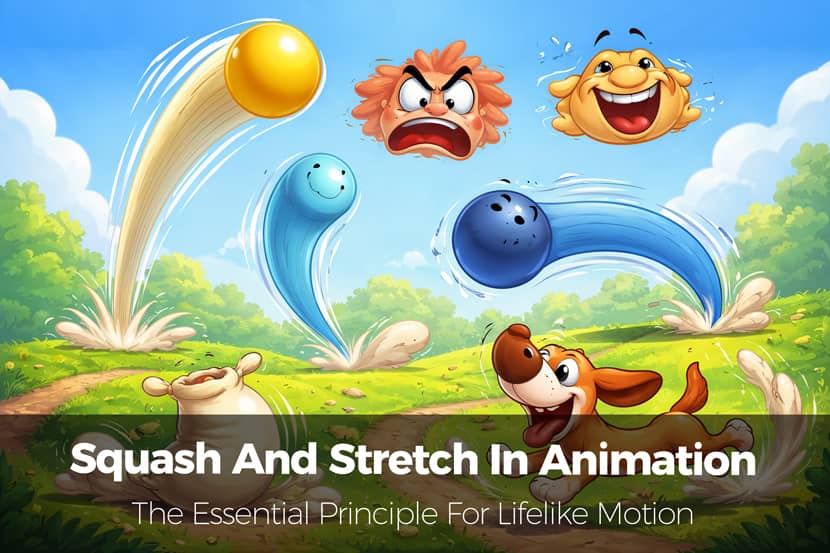
Animation has the ability to turn drawings, pixels, and polygons into living, breathing performances. However, even the most exquisitely crafted character may feel rigid and robotic if one essential principle is absent. We'll look at the fundamental concept that gives motion its vitality, mass, and individuality today. By the end of this guide, you'll know what squash and stretch are and how to utilize them with confidence in your own work, whether you're animating for games, 2D, or 3D.
Because objects move without responding to force, animation that lacks squash and stretch frequently appears inflexible. Shapes ignore acceleration, impact, and gravity when they move in a completely unaltered state. As a result, the movement is technically correct but not emotionally or physically convincing.
Disney animators famously described this as "by far the most important" of the 12 principles of animation. Frank Thomas and Ollie Johnston established it as the cornerstone of believable motion in The Illusion of Life. They realized that viewers don't just want movement, but they also want to feel weight, energy, and physicality.
What Is Squash and Stretch in Animation?
Squash and stretch is the animation principle of compressing or elongating a character or object to emphasize its weight, speed and impact, while the total volume of the shape stays constant.
It became the first of Disney's 12 principles of animation after being first codified by Frank Thomas and Ollie Johnston in The Illusion of Life. The basic principle is straightforward: forms do not suddenly acquire or lose mass; rather, they respond to motion and impact.
Consider a rubber ball, for instance. Because of its speed, it extends vertically as it falls. It squashes horizontally upon impact with the ground. Then it bounces back, stretching once more as it speeds up. The shape changes, but the volume remains the same.
Whether it's a stylized Pixar hero, a bouncing creature in a game, or a cartoon figure, this visual logic holds true for almost all animated objects. In the absence of this distortion, motion seems unrelated to physics.
Why Is Squash and Stretch the Most Important Animation Principle?
Because it communicates weight, flexibility, and material qualities, Squash and Stretch principle is regarded as the most significant animation concept. When their forms expand and contract in response to motion, even still drawings can come to life. The deformation of a hefty bowling ball is minimal. A rubber toy makes a dramatic squash. Without dialogue, the viewer comprehends the content and mass.
This idea is universal. According to RebusFarm's article on "The Rubber Hose Art Style That Defined Animation", it was greatly exaggerated in classic 1930s rubber hose cartoons. Although it is used more quietly in contemporary CG movies, the basic idea is the same. Squash and stretch create the appearance of life in cartoons, realistic movies, and video games.
How Does Volume Preservation Work in Squash & Stretch?
In order to make the object's total mass appear constant, volume preservation makes sure that as one dimension contracts, another expands proportionally.
An object's breadth must increase if its height decreases. It must narrow if it stretches higher. Ignoring this guideline breaks plausibility by making objects appear to grow or shrink unnaturally. The brief Blender demonstration in this video illustrates a typical rigging problem. Volume loss around places like the wrist as a character bends to explain how this functions in a real production setting. Enabling the Armature modifier's "Preserve Volume" option immediately makes the deformation more natural and keeps the mesh from collapsing. However, the video also explains that this feature can sometimes create unwanted bulging. A creative configuration that uses weight painting, a specialized vertex group, and a duplicated modifier to fine-tune only the troublesome regions is the answer.
As another example you can think about three materials. Rubber balls squash considerably. A tennis ball undergoes mild deformation. The shape of a bowling ball hardly changes. Based on the characteristics of the material, the animator determines how much deformation takes place.
Consistency is crucial. The illusion is destroyed if your character compresses significantly after landing and then doesn't return to its initial size. Even in stylized worlds, Animation must respect internal physical logic.
Bouncing Ball Animation: The Classic Squash and Stretch Exercise.
The bouncing ball animation, which separates physics without character complexity, is the fundamental exercise for understanding squash and stretch.
Students usually begin by animating the arc path. The ball curves cleanly as it moves. Next, important locations are added: maximal squash during impact, stretch during descent, and stretch again during ascent.
The behavior changes when the material changes. As we have already mentioned, Squash and stretch are accentuated by a rubber ball. The distortion of a tennis ball is mild. A bowling ball rebounds less and changes shape very little.
This simple exercise can teach us timing, spacing, arcs, and deformation control. It also connects to the concept of persistence of vision, explained in RebusFarm’s article on "What Is Persistence of Vision?". The illusion works because frames blend in the viewer’s eye.
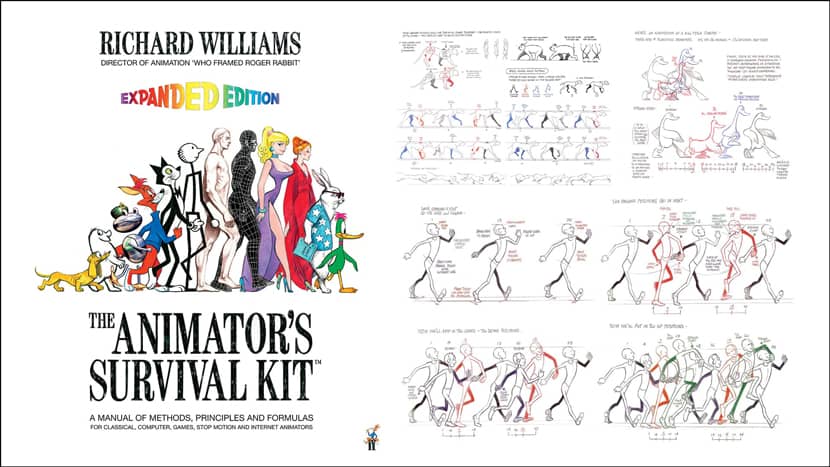
Richard Williams, the legendary animator best known for directing animation on Who Framed Roger Rabbit, in The Animator’s Survival Kit - the book that was first published in 2001 and has since become one of the most respected animation textbooks in the industry - repeatedly emphasized mastering the bouncing ball before moving on. It remains the most efficient way to internalize how force affects form.
A helpful companion to this idea is the video below, which explains why the bouncing ball is such a powerful teaching tool and especially when transitioning into 3D animation. The instructor highlights that while the bouncing ball teaches many of the 12 principles in a simple way, complete beginners in 3D must first understand how the computer "thinks", including keyframes, interpolation, hierarchy, and animation curves. It's actually a reminder that whether you're animating a ball or something more complex, such as a character's arm, the same core mechanics (arcs, weight, spacing, and deformation) can give believable motion.
Squash and Stretch in Character Animation.
Characters are more complex than balls, but the way we can animate it remains identical as their bodies react to motion and emotion through subtle deformation.
How Does Squash and Stretch Apply to Facial Expressions?
When it comes to facial expressions, squash and stretch works by distorting features to enhance emotion while maintaining convincing structure.
The face arches upward in surprise, the mouth lengthening, the eyes widening. The face squashes in rage, the cheekbones tightening and the brows pressing down. Eyes slightly compress and cheeks rise in joy.
The reasoning behind these modifications is the same, whether they are subtle in realistic animation or excessive in stylized flicks. Through form variations, the audience may read emotion.
Squash and Stretch in Body Movement and Action.
Squash and stretch characterize physical impact and energy in full-body motion. Let's take a jump sequence for example. The body squashes in anticipation of departure. It expands along the arc in midair. When it lands, the impact causes it to squash once more. Because the body responds to force, the action feels energetic.
Subtle compression is also necessary for walk-run cycles. The torso gently compresses when the foot touches the ground. Characters move strangely in the absence of this detail.
A common transition between bouncing balls and entire characters is the flour sack exercise. With just a little squash and stretch, a basic sack can bow, bounce, and convey emotion. You get the idea if you can bring personality to life in a flour sack.
This video offers a clear breakdown of how squash and stretch operates in full-body character animation, especially in cartoon styles. It demonstrates how the human body can be pushed beyond realism to enhance emotion while structured by a rigid skeleton. The lesson also reminds us that rigid materials should not deform, and that the amount of squash and stretch depends on elasticity, weight, and stylistic intention.
Squash and Stretch Examples in Films and Games.
Different styles use the same principle at different intensities.
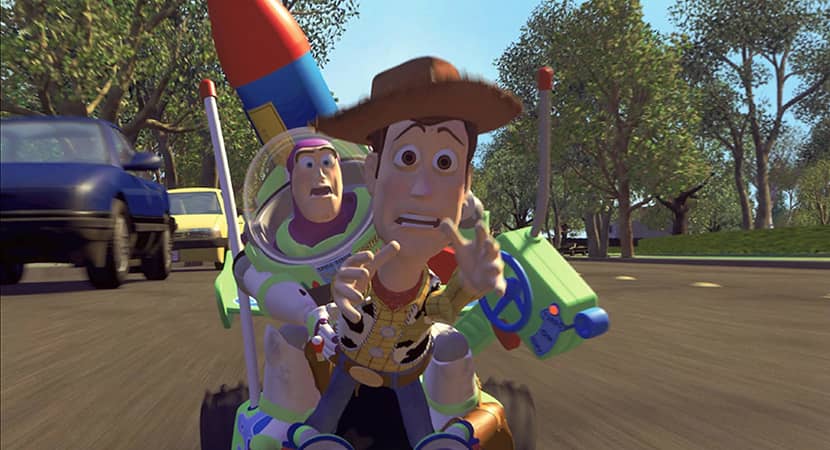
Disney and Pixar films such as Toy Story, Frozen, and Encanto use subtle deformation that supports emotion without breaking realism. Faces stretch just a bit during expression changes. Bodies compress gently on impact. The audience rarely notices consciously, but feels the effect and that's the most important.
Exaggerated distortion is used for impact and fun in stylized movies like Spider-Man: Into the Spider-Verse and cartoon comedies like Looney Tunes. Smear frames increase speed and energy by drastically stretching characters across space.

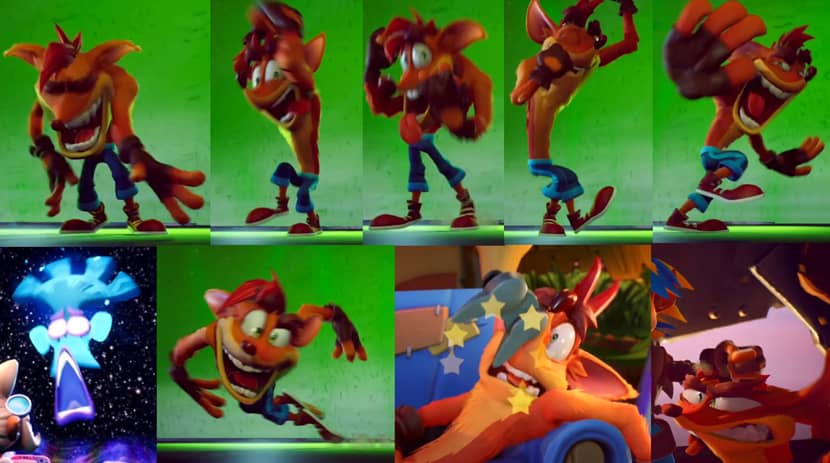
In video games, responsiveness is also very critical. Characters like Hollow Knight use subtle deformation to convey weight while maintaining stylized design and Crash Bandicoot squashes and stretches during jumps and spins to enhance readability.
Squash and Stretch Techniques in 2D vs. 3D Animation.
The animator has total control over shape creation in 2D animation since they draw every distorted frame directly.
Without being limited by technological limitations, artists are able to push forms artistically. Exaggeration turns into a timing and drawing skill issue.
Rigging determines deformation in 3D animation. Animators use bone scaling, blend shapes, and lattice deformers. Squash and stretch configurations are possible with Maya, Blender, and Cinema 4D tools, but they need preparation.
Avoiding a "rubbery" feel is a common 3D problem. Digital models can look artificial if deformation lacks proper volume control. Flexibility is ensured while maintaining structure through careful rigging.
Rendering performance becomes crucial for creating high-quality 3D animation sequences. Render farms, such as RebusFarm, assist artists in processing complex scenes quickly without sacrificing iteration speed when animation is complete.
Common Squash and Stretch Mistakes to Avoid.
Exaggeration can undermine believability. The classic advice is "feel it, don't see it". In realistic scenes, the audience may detect too much deformation if it is too obvious.
Another error is inconsistent volume. Unintentionally growing or shrinking objects break the immersion.
Errors in timing also lessen impact. Deformation must match force. Motion feels disjointed if squash happens too late or too early in relation to contact.
Finally, physical distinctions are ignored when the same deformation is applied to all materials. Rubber should not squash like a metal robot. Though usually within reasonable bounds, even inflexible characters may employ slight distortion.
How to Practice Squash and Stretch Animation.
Practice is best achieved by making small, steady improvement. With just one bouncing ball, begin. Increase the number of bounces with decreasing height. Next, give various materials life. Proceed to a bag of flour. Lastly, add animation to a sequence of character jumps.
It works better to build gradually rather than go straight into complicated settings. We have to learn the basics first!
Examine high-end movies frame by frame. Pause Pixar movies and examine them frame by frame. Examine cartoon impact frames. See how forms evolve and reappear.
Consistency and repetition build instinct. Instead of actively calculating correct deformation, you will eventually start to "feel" it.
Frequently Asked Questions About Squash And Stretch In Animation.
What is squash and stretch in simple terms?
Squash and stretch is when an animated object changes shape during movement to show force and weight while keeping its volume consistent.
Can squash and stretch be used in realistic animation styles?
Yes. In realistic styles, deformation is subtle but still there. Even slight compression during impact improves believability.
Should rigid objects like robots use squash and stretch?
Structural or minimum deformation is acceptable for rigid things, but it must be consistent with material logic. Weight can be suggested with subtle scaling or mechanical compression without sacrificing realism.
How do I know how much squash and stretch deformation to use?
Material, style, and emotional tone all influence how much is appropriate. Examine reference material and contrast overt versus covert methods. It's effective if it feels consistent and natural.
What software is best for learning squash and stretch animation?
Well, any major animation software can teach the principle. Deformation tools are supported by Blender, Maya, and Cinema 4D. It is more important to understand timing, volume, and physics than the program.
We appreciate you reading this guide. We hope it helped you see squash and stretch as a strategic basis for making motion that feels alive, deliberate, and emotionally compelling, rather than a traditional animation technique. Understanding this idea makes storytelling more powerful, makes impacts more meaningful, and performances feel more natural. Animators should always focus on improving the physicality of motion, working with more control over time and deformation, animating confidently, and addressing creative difficulties.
Kind regards & Keep rendering! 🧡

About the author
Vasilis Koutlis, the founder of VWArtclub, was born in Athens in 1979. After studying furniture design and decoration, he started dedicating himself to 3D art in 2002. In 2012, the idea of VWArtclub was born: an active 3D community that has grown over the last 12 years into one of the largest online 3D communities worldwide, with over 160 thousand members. He acquired partners worldwide, and various collaborators trusted him with their ideas as he rewarded them with his consistent state-of-the-art services. Not a moment goes by without him thinking of a beautiful image; thus, he is never concerned with time but only with the design's quality.