
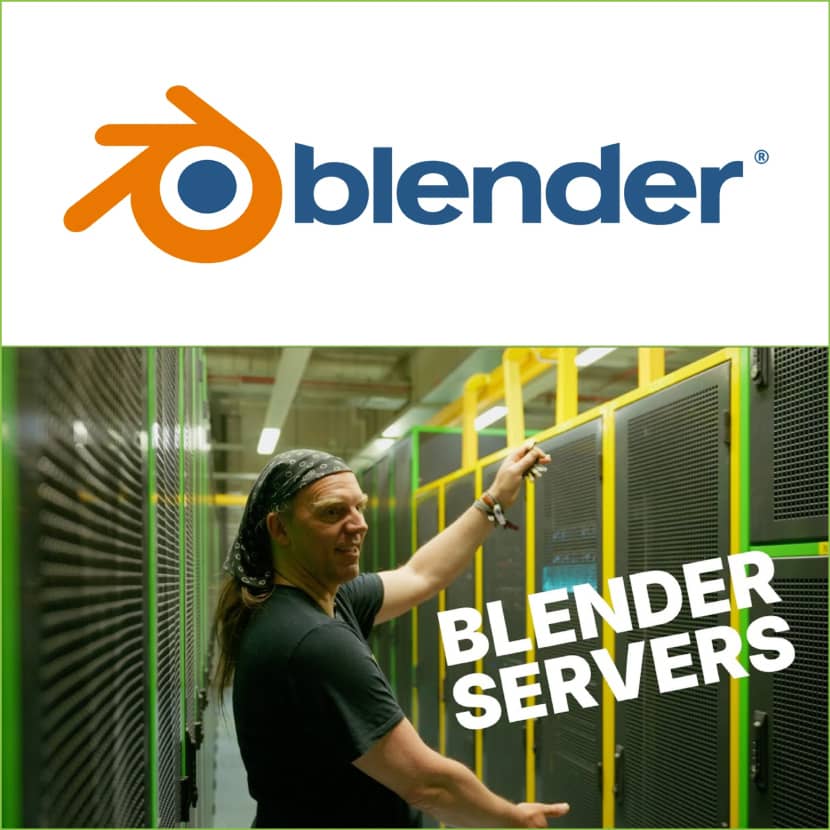
Behind every line of code, there is hardware, people, and history. In Blenderheads Episode 11, Blender opens the doors to its server rooms, storage racks, and old render clusters, revealing a quiet but emotional transition that marks the end of a long, self-hosted era and the beginning of a new chapter in the cloud.
A Look Inside Blender’s Physical Backbone.
For a long time, Blender was physically constructed at the headquarters in addition to being developed there. The computers in the server room at Blender HQ were in charge of compiling Blender for all platforms, executing build bots for each commit, providing internal storage for the editorial department and Blender Studio, and even handling CPU rendering tasks. This infrastructure symbolized Blender’s independence and hands-on philosophy: everything critical ran under their own roof.
Entering the server room, which was crowded, dark, and buzzing with machinery that had been operating nonstop for years, made a powerful impression. Before reaching millions of users worldwide, nearly every Blender version went through actual hardware testing here.
Build Bots, Render Nodes, and Handmade Clusters.
Custom-built machines, which were small systems meticulously put together with just enough space for CPUs, cooling, storage, and airflow, were among the racks. These were practical, useful, and made to change as Blender did; they weren't consumer-grade builds.
The render cluster, which was first constructed for the short film Sintel fifteen years ago, is among the most famous pieces of technology. Tightly packed motherboards, painstakingly cut apertures, and handmade metal frames came together to create one of Blender's most significant open movies. Though it wasn't perfect, it worked and got ingrained in Blender's DNA.
From Hardware Control to Cloud Reality.
As time went on, Blender added more long-term machines and grew into an external data center in Amsterdam. However, expectations for scalability increase, hardware ages, and maintenance becomes more demanding. The conversation gradually turned to a future in which Blender would relinquish ownership and upkeep of physical hardware while retaining complete control over its software.
The episode refers to the decision to shift infrastructure to managed cloud environments as "the end of an era." It's a strategic evolution rather than a loss of independence. Decommissioning racks and removing cables can be emotionally taxing for developers who enjoy creating and maintaining equipment. Servers that once were Blender are carefully powered down, dismantled, and documented.
Preserving Blender’s History.
Blender decided to keep this hardware rather than allow it to disappear quietly. A Blender history museum featuring relics from the 1990s and early 2000s, including old manuals, original logos, notebooks containing early development sketches, and even internal projects and games made long before Blender became what it is today, is being arranged in glass cabinets.
Visitors may follow Blender's development from its 1992 debut showreel to its early commercial guides and current status as an open-source powerhouse. This isn’t nostalgia but a documentation of a rare software story built with transparency and community at its core.
More Than Servers - A Cultural Shift.
The episode isn’t just about moving machines. It has to do with recognizing progress. Without sacrificing its principles, Blender is moving from a tiny, highly hands-on infrastructure to a more contemporary, scalable one. Blender retains control, vision, and a community-first mindset even if the hardware moves.
Progress doesn't always come with fireworks. Sometimes it comes quietly with unplugged cables, empty racks, and a final look at machines that carried an entire ecosystem on their shoulders.
🎥 Watch the full Blender episode:
About Blender.
Blender is the organization behind the free and open-source 3D creation suite used for modeling, animation, rendering, VFX, simulation, and more. Developed openly with the support of a global community, Blender is known for its independence, transparency, and continuous innovation. From feature films and games to architectural visualization and motion graphics, Blender remains one of the most influential tools in the 3D industry. Built by artists, for artists.